
Under the Eiffel Hall at the Château de Marolles, the Hier & Aujourd’hui Festival brought the Romantic lied face to face with contemporary creation. An evening of voices, breath and percussion, balancing Schubertian tenderness with sonic unease.
On July 24, night gradually fell over the Château de Marolles in Génillé, in France’s Touraine region. Beneath the metal structure built by Gustave Eiffel, the audience took their seats in the open air. The stage was open, and so was the listening. For its sixth edition, the Hier & Aujourd’hui Festival did not simply juxtapose different eras: it placed them face to face.
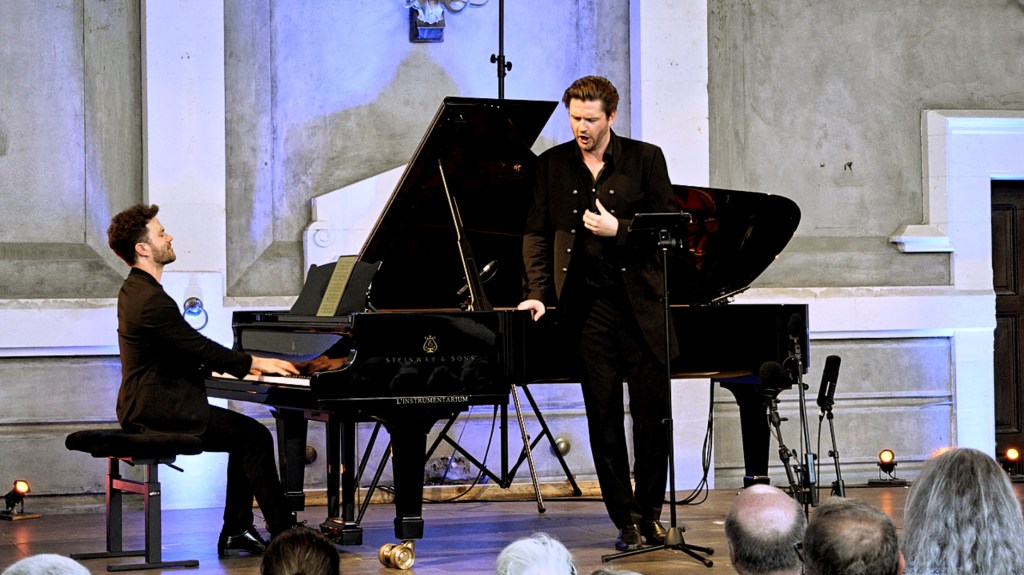
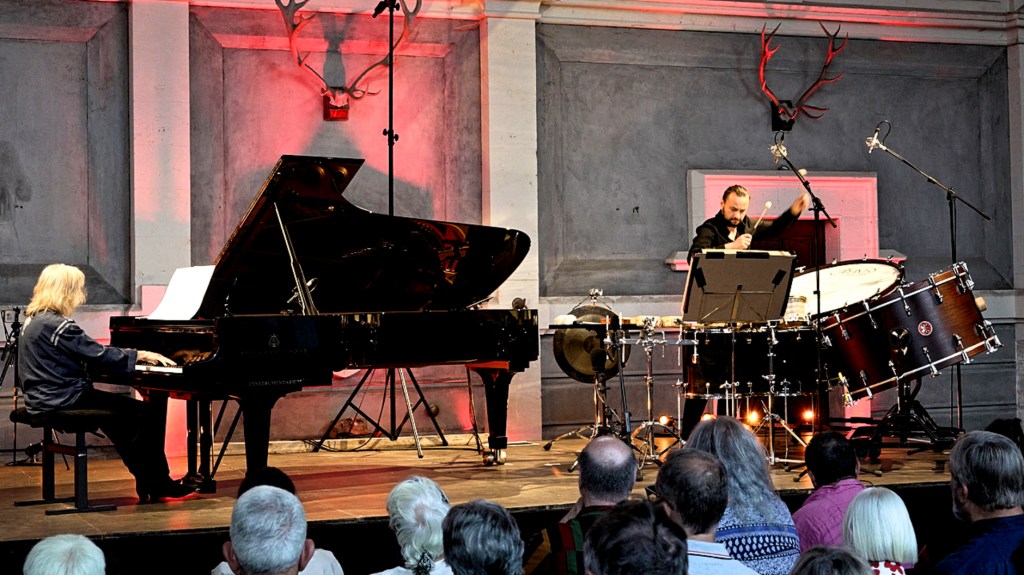
First came Schubert, performed by baritone Samuel Hasselhorn and pianist Ammiel Bushakevitz. This was followed by Chants de l’ombre (Songs of Shadow), a world premiere by Anne-Marie Fijal, performed by the composer at the piano with Polish percussionist Leszek Lorent.
Schubert’s lieder in all their glory
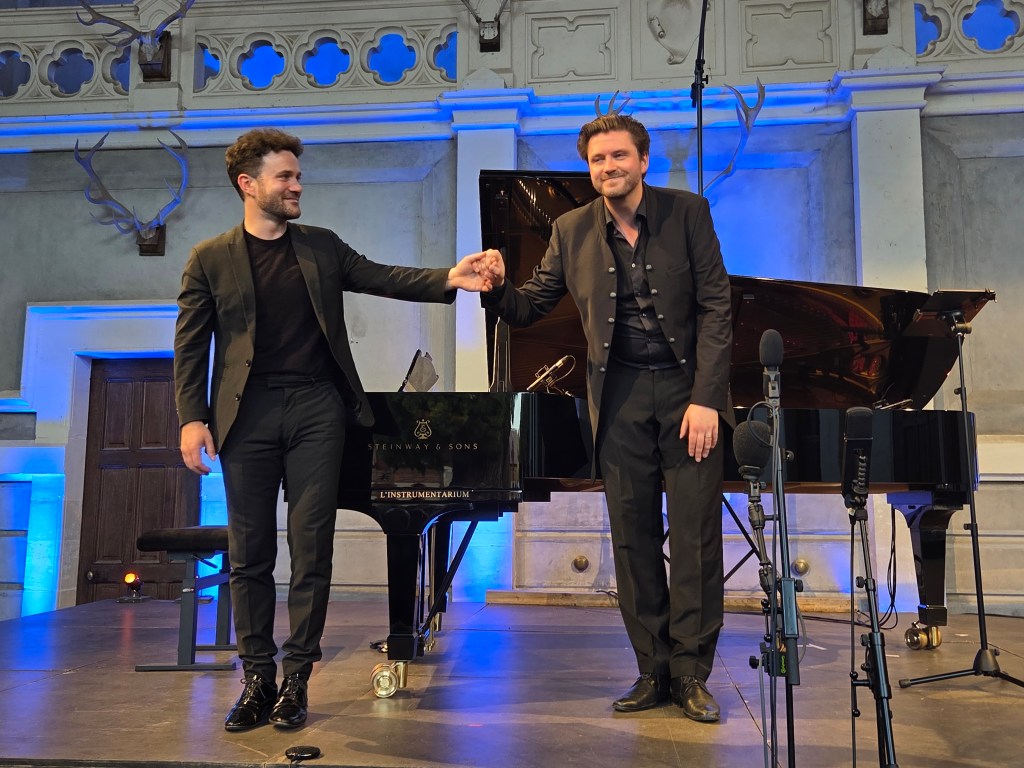
Schubert’s lieder possess the breath of lyricism, vitality and Romanticism. Samuel Hasselhorn sings with a warm, gentle voice. At the piano, Ammiel Bushakevitz plays with a light, almost transparent touch. The piano does not merely accompany the singer: it opens up spaces, suspends time and gives the voice fresh momentum.
The two artists have known each other for around fifteen years. They began performing together during the Covid period, working on the lieder of Winterreise (Winter Journey). Their collaboration led to the Schubert 200 project, launched in 2023 with the record label Harmonia Mundi.
Samuel Hasselhorn sums up their story
“We had to do something together. That is how the Schubert 200 project was born. Since then, every year, we have recorded our albums in Berlin, in the same studio, with the same sound engineer and the same piano.”
Ammiel Bushakevitz describes the bond they share beyond the written score
“I think the composer trusts the performer to bring out the soul of the music—to reveal what lies behind the score. Samuel does this spontaneously, and it is very inspiring.”
Each lied becomes a scene in its own right.

After Schubert, the atmosphere changed. In Chants de l’ombre, receiving its world premiere, Anne-Marie Fijal plunged the audience into a darker soundscape. She performed at the piano alongside Leszek Lorent, a Polish percussionist.
Their instruments answered, searched for and collided with one another. The piano struck out; the percussion extended its resonance. A tense dialogue took shape, without scenery or an explicit narrative. In her work, the composer evokes pain while celebrating the beauty of the ephemeral.
Anne-Marie Fijal : from composition to stage
“This composition had been in my imagination. Leszek and I rehearsed rigorously, and today we said to each other: now we breathe—and we begin. After this premiere, all I want is to perform it again, because there is always room for progress.”
Anne-Marie Fijal began her career as a classical performer before turning to performance art and composition. She has worked with artists such as Ernest Pignon-Ernest and Carolyn Carlson. This trajectory can be felt in Chants de l’ombre, a work conceived as much for the stage as for the score, in which gesture matters as much as sound.
Beneath the Eiffel Hall, the Hier & Aujourd’hui Festival affirmed its artistic vision: to make the past heard while welcoming the present. Schubert and Anne-Marie Fijal were speaking the same language—the language of music.
Jean-Claude Djian
The first three albums in the Schubert 200 project received a Diapason d’Or :
- Die Schöne Müllerin (The Beautiful Miller’s Daughter).
- Licht und Schatten (Light and Shadow).
- Hoffnung (Hope).



Laisser un commentaire