
Roxane Gouguenheim : Art in Every Sense
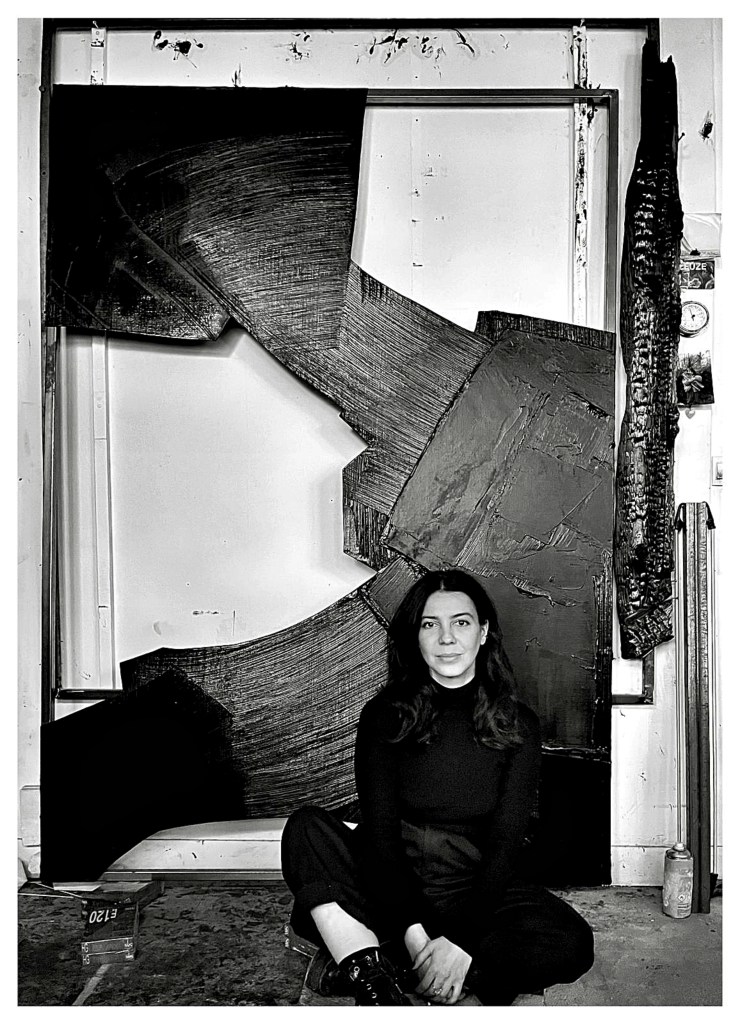
2026 is shaping up to be a milestone year for French visual artist Roxane Gouguenheim. After years of steady exploration, her work comes into full bloom at the Centre for Arts and Culture in Meudon, where her new exhibition Eiche Homo unveils large-scale paintings, delicate sculptures, and quiet yet powerful spaces that give her artistic voice complete freedom.
Opening Dark Times
Earlier this year, at Paris’s Galerie By Lara Setbon, Roxane Gouguenheim presented Opening Dark Times—a striking prelude to her Meudon exhibition. In the stark winter light bouncing off white walls, the artist, dressed in black, spoke softly yet with precision about her inspiration.
“Opening Dark Times is a tribute to Hannah Arendt’s Men in Dark Times,” she explains. “We’re living through our own dark period today. My goal is to find a way to open it up—to think from within the wreckage, through what’s been shattered, and imagine how to move beyond it. As a visual artist, I try to think through forms—through what those who came before us produced in times of crisis.”
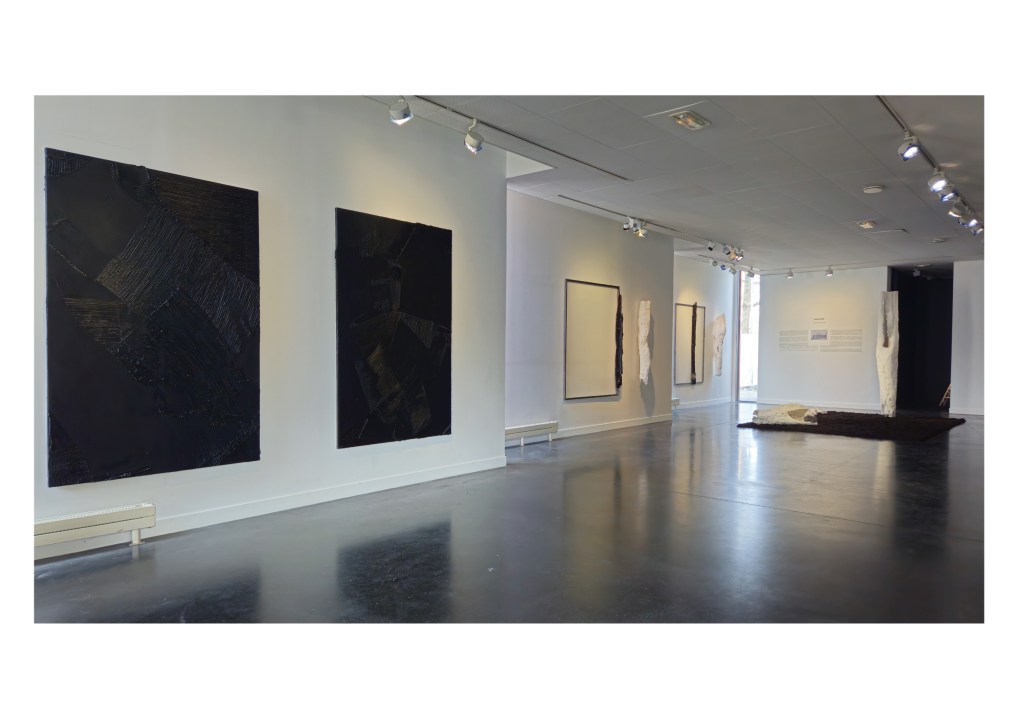
At the heart of the show were the Men in Dark Times canvases—an homage to Hanna Arendt, the German-Jewish philosopher forced into exile by Nazism. Near the entrance, a vast black painting featuring a yellow ring glowed like a trapped star. Another piece revealed black and gray shapes swirling over an ochre-yellow background, inscribed in Yiddish: “This is not a dawn, but a tear in the veil.”
“The canvases are stapled directly to the wall, like living skin—no frame,” says Gouguenheim. “The idea was to paint fast, out of need and urgency. If the times get darker, you can pull the canvas off, roll it up, and run.”
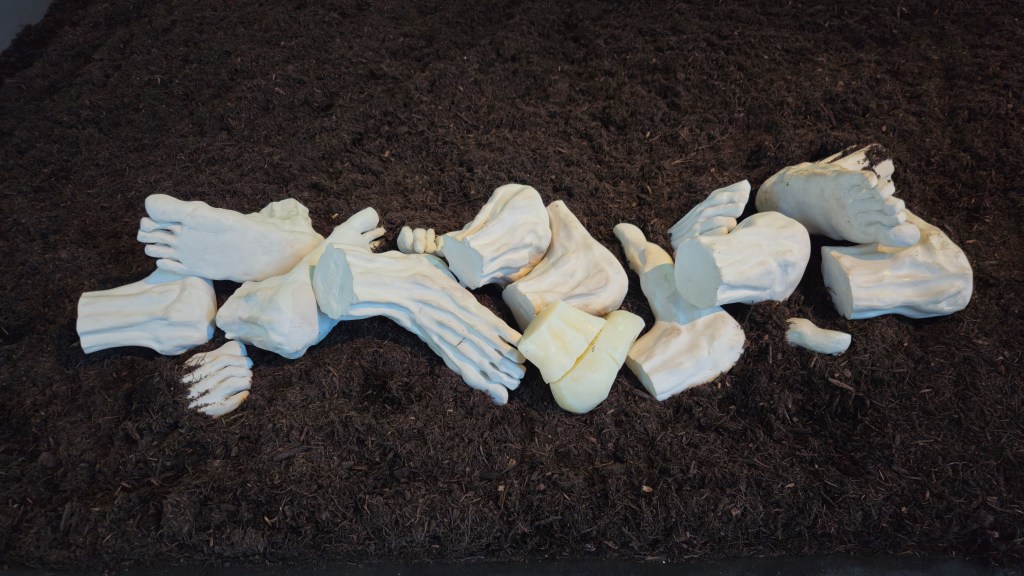
Hand-sculpted white clay and soap feet evoke exile; plaster legs lie somewhere between creation and disappearance. In Cry 1, Grey Red, a turbulent red mass cuts through a gray surface—“a visual scream,” says the artist, referencing the fall of the Weimar Republic. Deeply influenced by post-Holocaust Jewish thought, Gouguenheim grapples with the collapse of humanism itself.
Eiche Homo — From Goethe to Buchenwald
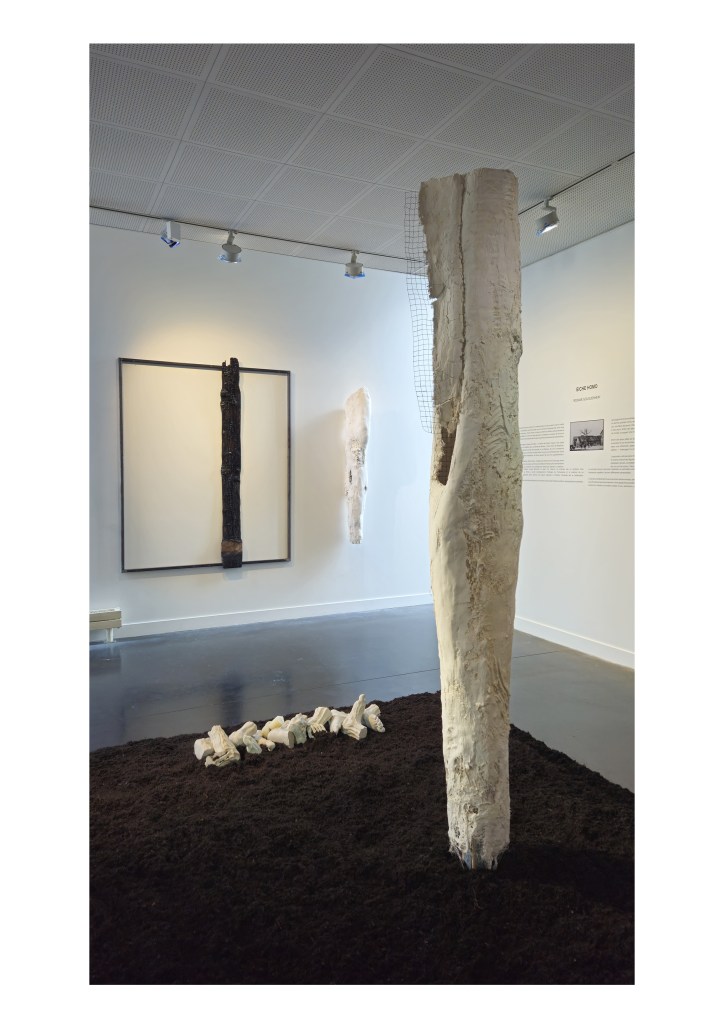
The Holocaust (שואה: “catastrophe, annihilation”) echoes through the works presented at the Centre des arts et de la Culture in Meudon. The exhibition Eiche Homo — Eiche meaning “oak” in German and Homo “man” in Latin — plays on the idea of the “man‑oak,” a symbol of strength and longevity. This metaphor resonates within an expansive space whose large volumes free the artist’s more imposing works. The title piece depicts Goethe’s oak in Buchenwald, the tree that stood in the center of the concentration camp and miraculously survived the flames. Legend has it Goethe once meditated under its branches—a haunting image of human culture persisting in barbarism.
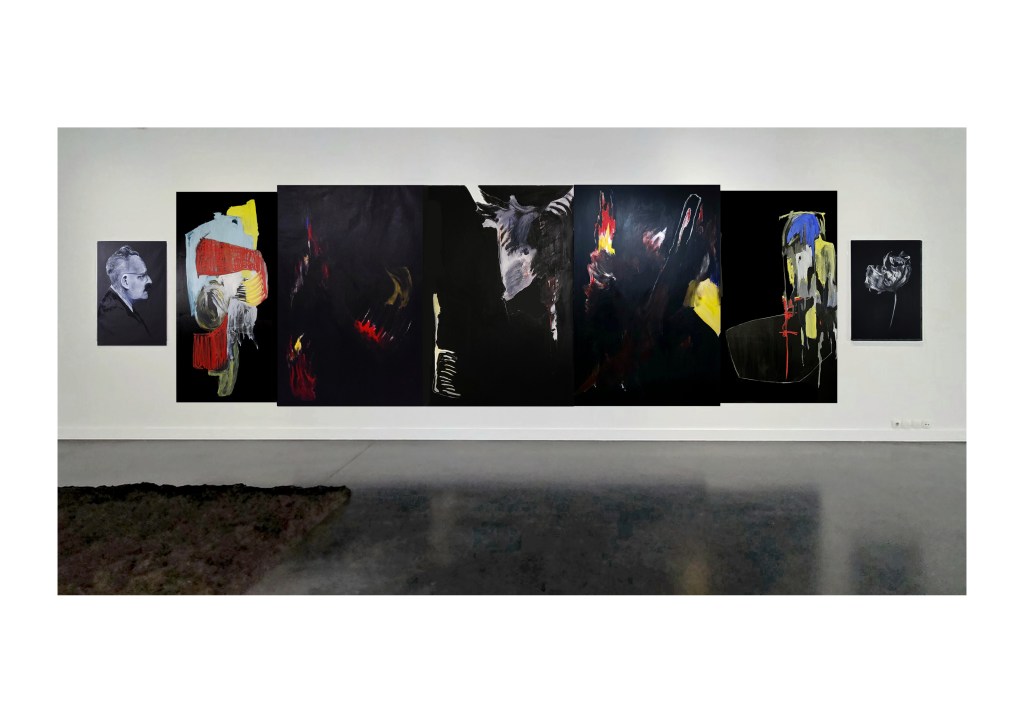
Facing it, the seven-paneled Nachtfeuer (“Night Fire”) opens with Walter Benjamin’s final portrait before his suicide in 1940, and closes with a poppy—symbol of morphine and escape. Between them, dark canvases of soot and shadow evoke the burning pogroms of Europe’s past.
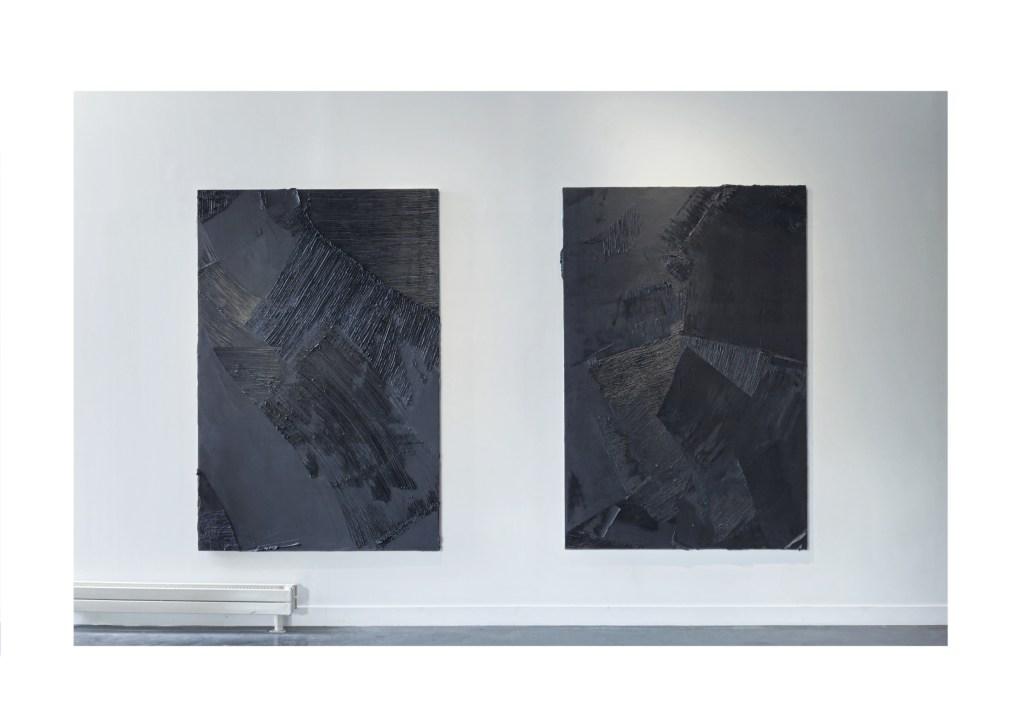
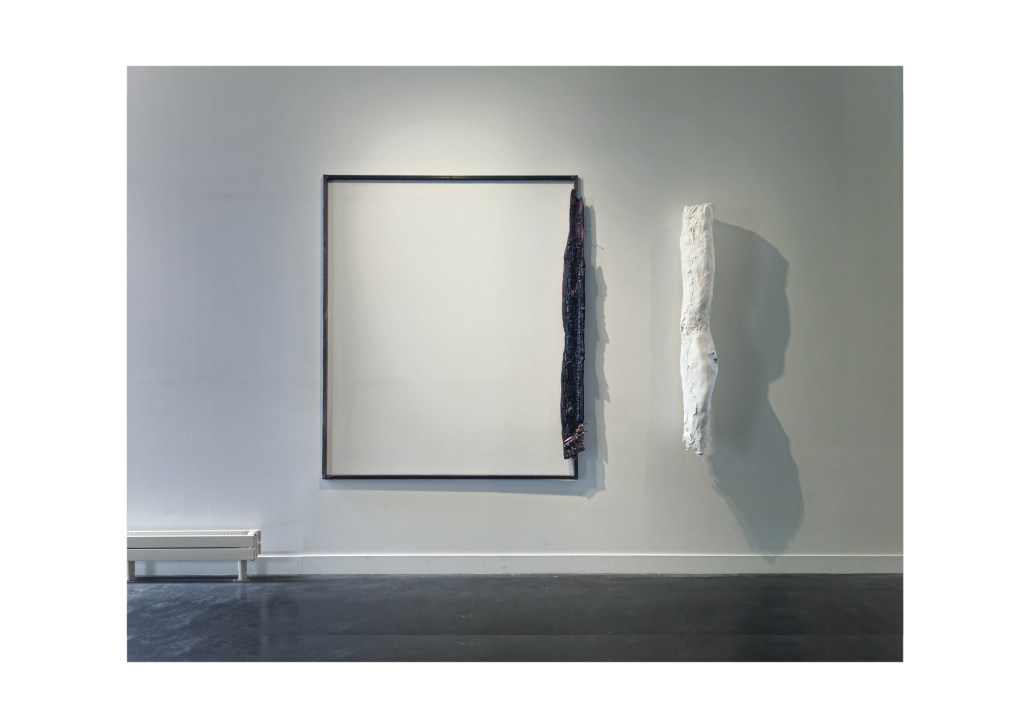
Other works, such as The Hypostases (black monochromes) and The Parresias (charred wood on metal frames), explore resistance and transcendence. An old stepladder engraved with Goethe’s “Orphic Primordial Words”—Dämon, Tyche, Eros, Anankè, Elpis—marks the artist’s physical and spiritual journey. Around them, life-size plaster legs and Hebrew–Yiddish text fragments amplify the Shoah’s ever-present echo.
Biblical figures wander through her universe: Rachel weeping, Judith striking, Jacob limping, Abraham hesitating. Through them, Gouguenheim traces a continuous thread from ancient anguish to modern resilience. Her intellectual companions—Hannah Arendt, Walter Benjamin, Emmanuel Levinas—ground this dialogue between thought and matter.
The Art of Sensing
For Roxane Gouguenheim, art isn’t just seen—it’s heard, breathed, and felt. Her work creates a conversation between textures, silences, and memory. In Meudon, these elements come together as both a collective remembrance and a testimony of endurance.
Eiche Homo stands as her most complete statement to date : an art of all senses, where tenderness meets defiance, where material becomes thought—and emotion, vision.
Jean-Claude Djian
Eiche Homo — March 24 to May 9, 2026 Centre for Arts and Culture, Meudon (France)

 Félix Magazine
Laisser un commentaire